
01
Keywords Live in Silos
Research files, listing drafts, and ad campaigns never sync—so your Amazon listing SEO ends up working against your Walmart listing optimization instead of reinforcing it.
The AI agent that runs catalog-level keyword research, intent clustering, and snippet optimization across thousands of SKUs—so your listings rank where buyers actually search.
Product listing optimization for Amazon and Walmart listings—and multi-marketplace catalogs. Keyword mapping, gap analysis, and marketplace-native SEO in one AI-driven workflow.
Listings Optimized
+4,281 SKUs updated
Every change flows through Amazon, Walmart, and Shopify seller APIs. No scrapers. No browser automation. No policy risk.
Every edit logged with timestamp, user, and before/after snapshot. Roll back any change in one click.
Nothing publishes without your sign-off — unless you enable auto-apply within limits you define.
Secure OAuth connection · Access tokens only, never your credentials · SOC 2 compliance on roadmap
Whether you manage 50 SKUs or 50,000, the right time to automate listing optimization is before rankings slip, not after.
Adding hundreds of new SKUs? Manual keyword mapping can't keep pace. Automate from day one to launch listings that rank.
Each platform has unique search algorithms and content rules. Catalog SEO adapts your listings for Amazon, Walmart Item Spec 5.0, Etsy, Shopify, and eBay without starting from scratch.
If impressions are dropping and competitors are climbing, your listings need fresh keyword coverage. The agent identifies gaps and rewrites content to recapture lost visibility.
Walmart's updated content schema demands compliant attributes and optimized copy. Catalog SEO validates every field against Spec 5.0 requirements before you publish.
First impressions in marketplace search set the trajectory. Use Catalog SEO to research demand, map keywords, and publish optimized listings from launch day.
You've built keyword lists. You've optimized your top sellers. Yet month after month, the same problems return: new SKUs launch without any search strategy, keyword cannibalization quietly kills your rankings, and half your catalog sits invisible while competitors claim the impressions you should own.
The truth is brutal: what works for 50 listings falls apart at 500—and becomes unmanageable at 5,000.
You're left wondering why your Amazon listing SEO is not working.
Scattered Spreadsheets
Inconsistent Optimization
Lost Impressions & Revenue
The traditional workflow is broken. Spreadsheets inevitably lead to chaos, costing you both visibility and sales.
Research files, listing drafts, and ad campaigns never sync—so your Amazon listing SEO ends up working against your Walmart listing optimization instead of reinforcing it.
Products hit the marketplace without semantic strategy, ranking for nothing while competitors capture demand from day one.
Parent and child ASINs target identical phrases, splitting authority and leaving your listing not ranking where it should.
Titles optimized for Amazon don't meet Walmart Item Spec 5.0 requirements, and Etsy copy doesn't translate to Shopify—so you maintain four versions poorly.
Teams avoid updating top performers because they lack safe testing environments—so optimization stalls and competitors catch up rapidly.
Marketplace SEO involves optimizing product listings on platforms like Amazon, Walmart, Etsy, and eBay to rank higher in their internal search results and convert more shoppers into buyers. Unlike website SEO, where you control hosting, site speed, and backlinks, marketplace SEO focuses entirely on what sellers can influence: titles, bullet points, descriptions, backend keywords, product attributes, images, pricing, and review signals. Think of it as a distinct discipline built around a closed ecosystem—one where the algorithm rewards relevance, completeness, and conversion performance rather than domain authority or page load time.
Optimizes product listings within a platform's search engine (Amazon A9/A10, Walmart Relevancy, Etsy Search). Ranking factors include keyword placement in titles and attributes, listing completeness, conversion rate, sales velocity, reviews, and pricing competitiveness. You work within strict character limits and category-specific attribute requirements. Technical infrastructure is owned by the marketplace—you cannot modify crawl behavior, page speed, or URL structure.
Optimizes web pages for Google, Bing, and other external search engines. Ranking factors include backlinks, domain authority, page speed, mobile usability, schema markup, and on-page content quality. You control the entire technical stack—hosting, redirects, canonical tags, robots.txt, sitemap structure. Content length and format are flexible; there are no marketplace-imposed character caps or attribute schemas.
Imagine you sell stainless steel insulated water bottles on Amazon. Keyword research surfaces a demand cluster of three high-intent phrases:
Traditional SEO — would target these phrases across blog posts and category pages.
Marketplace SEO — takes a different path — mapping each keyword to a specific listing element:
The result: one listing engineered to capture multiple high-intent queries without cannibalizing other SKUs or violating platform guidelines.
Every optimization starts with structured outputs you can review, export, and act on. No black boxes—just actionable artifacts with full visibility into what changes, why, and which metric each edit targets.
A cleaned, deduplicated list of every search term relevant to your catalog—sourced from marketplace autocomplete, competitor listings, search query reports, and third-party keyword tools. Each keyword includes monthly search volume, competition score, and source attribution so you know exactly where it came from and how reliable the data is.
CSV and Google Sheets export included. Bulk-ready for agencies managing large catalogs.
Keywords grouped by buyer intent and semantic similarity, ranked by revenue potential and conversion likelihood. Each cluster shows primary intent (informational, comparative, transactional), priority tier, and estimated traffic opportunity—so you focus optimization effort where it drives the most sales.
Export as CSV or sync directly to Google Sheets for team review.
A complete keyword-to-SKU assignment matrix that shows which terms belong to which product or variation, with specific placement recommendations for title, bullets, backend search terms, and description fields. Includes cannibalization flags when multiple SKUs compete for the same keyword.
Bulk-ready outputs designed for keyword mapping across Amazon, Walmart, and multi-marketplace catalogs.
Optimized title and bullet copy formatted for marketplace search results—ready for A/B testing or direct publication.
A prioritized task list in agent-ready format: each task specifies the SKU, the change, the target field, and the metric it aims to improve.
Every artifact is exportable. Every recommendation is traceable. You see exactly what the AI proposes, why it matters, and what outcome it targets—before anything goes live.
Find, clean, and consolidate keywords from your catalog and competitor gaps.
Cluster keywords by search intent and prioritize high-value demand.
Map keyword clusters to SKUs and eliminate cannibalization across your catalog.
Optimize titles, bullets, and images for marketplace search results and AI shopping assistants.
Apply platform-specific requirements for Amazon, Walmart Item Spec 5.0, Etsy, Shopify, and eBay.
Track rankings, measure share of voice, and run A/B tests to prove uplift.
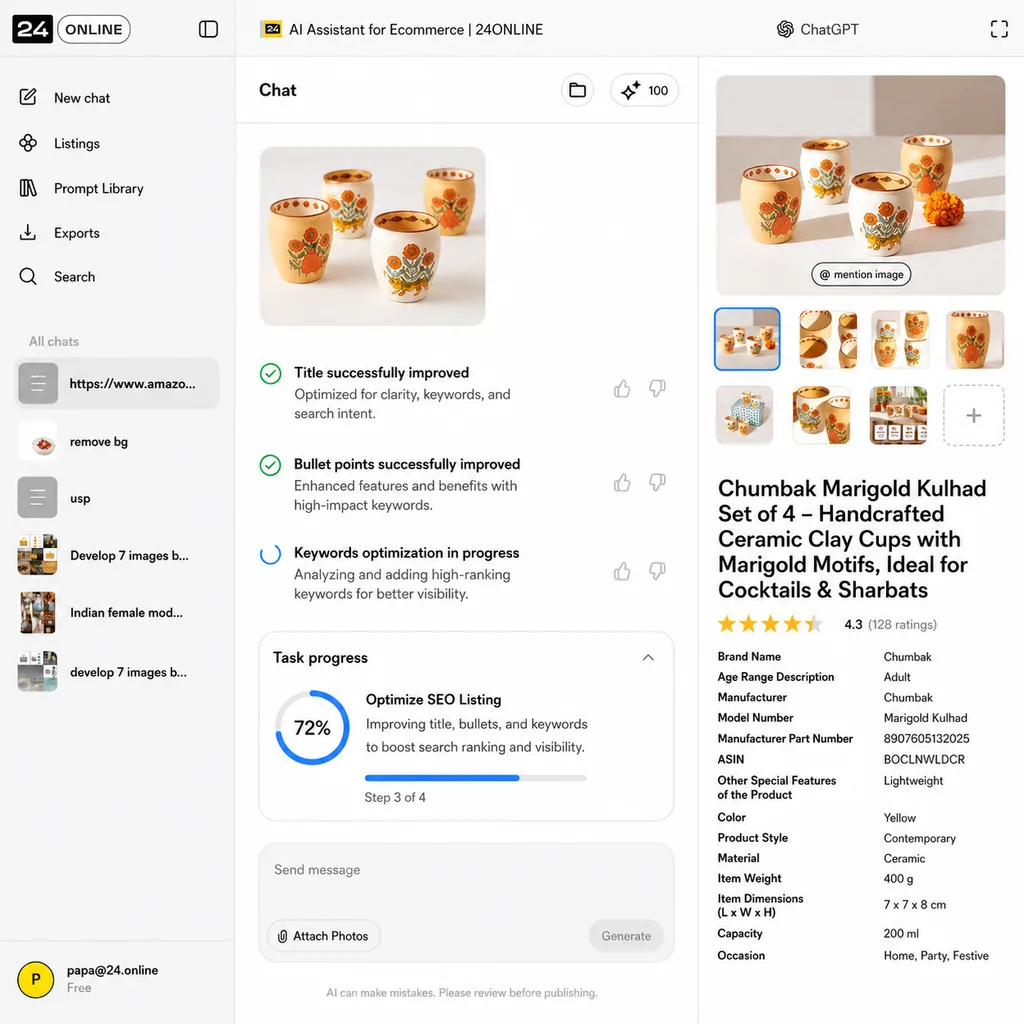
Chat-based listing optimization that turns plain-language requests into catalog-wide action
The 24.online AI Seller agent operates through a conversational interface where you describe what you need and the system handles the rest. Instead of clicking through dashboards or manually editing spreadsheets, you type a request in natural language. The agent interprets your intent, builds a structured task backlog, generates the required artifacts, and queues everything for your review—or executes automatically if you've enabled hands-free listing optimization within your defined guardrails.
A typical session might start with something as direct as "Optimize 500 listings for the wireless earbuds cluster" or "Create a keyword map for my top 50 SKUs." You can request snippet variants tailored for Walmart search, ask for gap analysis against your top three competitors, or instruct the agent to prioritize SKUs by revenue contribution. The AI Seller agent parses each request, determines the sequence of subtasks—keyword extraction, content generation, compliance checks, conflict resolution—and returns a concrete plan with draft deliverables attached. You see exactly what will change before anything touches your live catalog.
Every request produces a clear set of artifacts: optimized titles, rewritten bullets, refreshed backend keywords, or a full keyword-to-SKU map depending on the task. The agent groups changes into reviewable batches and flags potential issues such as keyword cannibalization or character-limit violations. You approve individual edits, accept an entire batch, or toggle autopilot mode to let the system apply changes automatically within the boundaries you've set—price thresholds, content guidelines, marketplace rules, and any other constraints you define.

Chat-driven interface where natural language commands become structured tasks, draft content, and live marketplace updates — all in one workspace.
Optimize titles and bullets for my top 100 SKUs targeting "portable charger" keywords.
 24.online Agent
Understood. I'll pull current listings, run keyword gap analysis against top competitors, and generate optimized titles and bullets for 100 SKUs. Estimated completion: 4 minutes. You'll receive a draft batch for review before anything is published.
Also flag any SKUs where we're cannibalizing our own keywords.
24.online AgentAdded to the task. I'll include a cannibalization report with recommended keyword reassignments. You can approve changes per SKU or accept the full batch at once.
Keyword gap analysis – 100 SKUs
Title optimization – 100 drafts
Bullet rewrite – 100 drafts
Cannibalization audit
Once approved, changes are pushed directly to your connected marketplaces via official seller APIs. With secure OAuth integrations, we prioritize data integrity and auditability—every change is logged and timestamped. Should a listing fail validation, the system surfaces immediate, actionable fixes, effectively turning complex bulk catalog management into a simple, high-confidence, single-flow workflow.
Connect your seller account and send your first command in under two minutes.
Every team operates differently. Some want full visibility before any change goes live. Others need to move fast across thousands of SKUs. 24.online gives you three distinct control modes—so you can start cautious, build confidence, and scale automation at your own pace.
Review everything, publish nothing without your approval
The AI analyzes your catalog, identifies keyword gaps, and generates optimized titles, bullets, and backend terms—but every output stays in draft. You review recommendations one by one, edit as needed, and decide what gets published. Ideal for teams new to AI-assisted SEO or working with sensitive product categories.
Approve batches, not individual SKUs
The AI groups optimizations into logical batches—by category, brand, or priority score—and presents each batch for your review. One click approves the entire set; one click rejects it. You maintain oversight without the bottleneck of SKU-by-SKU approval. Perfect for teams scaling from dozens to hundreds of listings.
Automation with guardrails—fast, safe, auditable
Define your rules once: which fields can change, which categories are in scope, maximum SKUs per run, and any pricing or content boundaries. The AI applies optimizations automatically within those limits—no waiting, no bottleneck. Every action is logged, and you can pause or roll back at any time.
You don't have to commit to full automation on day one. Most teams begin in Manual mode to understand how the AI thinks, then move to Semi-Auto as trust builds. When you're ready, Autopilot handles bulk updates across your entire catalog—while you stay in control of the boundaries.
Every edit is traceable, reversible, and bound by rules you define. No surprises.
Automated optimization should never feel like a black box. 24.online treats every catalog change as a controlled operation: each edit carries a clear rationale, passes policy checks before publication, and remains fully reversible in your change history. Enterprise teams and agencies rely on this governance layer to scale SEO work without sacrificing oversight or compliance.
Every modification links to a specific intent cluster or ranking signal. When the agent rewrites a bullet point, the audit log records which keyword gap it closes and which search‑visibility metric it targets. You always know the "why" behind each change.
Before any update reaches your marketplace account, 24.online validates it against your approval rules: field‑level permissions, character limits, brand‑voice guidelines, and platform compliance thresholds. Edits that fall outside agreed parameters stay in draft until you review them.
The agent operates strictly within the fields, SKUs, and value ranges you authorize. It cannot push a price change if you only permitted title updates, and it cannot exceed the uplift thresholds you set. Boundaries are enforced programmatically, not by trust alone.
Every action is timestamped and stored in an immutable audit log. You can filter by SKU, date, user, or change type, compare any two versions side by side, and export records for internal reviews or client reporting.
24.online connects to your seller accounts through official OAuth flows and secure access tokens. We never store your marketplace passwords. Tokens are encrypted at rest and can be revoked from your dashboard at any time.
Review proposed edits field by field. Additions appear highlighted, deletions are struck through. On mobile, toggle between fields one at a time for a clear, uncluttered view.
Stainless Steel Travel Mug 16oz Insulated
Stainless Steel Travel Mug 16oz – Vacuum Insulated, Leak-Proof Lid
Rationale Adds high-volume keyword "vacuum insulated" and addresses "leak-proof" intent cluster identified in gap analysis.
Keeps drinks hot or cold for hours.
Keeps drinks hot up to 12 hours or cold up to 24 hours – ideal for commutes, travel, and outdoor adventures.
Rationale Inserts specific temperature-retention claims and usage-context keywords to improve relevance for "travel mug for commute" queries.
Proposed description exceeds Walmart Item Spec 5.0 character limit by 47 characters. Edit trimmed automatically; review before approval.
Restore the prior version instantly. The rollback itself is logged, preserving a complete chain of custody for every SKU.
Safe automation means you stay in control. With policy checks, field-level permissions, and one-click rollback, scaling your catalog SEO never comes at the cost of governance.
We believe in honest roadmaps. Here's exactly what you can use right now, what's in beta, and what we're building. No vague promises—just clear timelines and working features.
Automated scoring for every SKU across titles, bullets, descriptions, images, and A+ content. Identifies exactly what's hurting your search visibility and conversion.
Generate and optimize titles, bullet points, descriptions, and backend keywords. Built for marketplace search algorithms and optimized for LLM-driven shopping assistants like Rufus.
Background removal, quality enhancement, infographic generation, and lifestyle context images—all tuned to marketplace image requirements.
The AI agent identifies optimization opportunities, creates tasks, and executes improvements across your catalog without manual intervention.
Push optimized content to Amazon, Walmart, Etsy, Shopify, and eBay simultaneously. One source of truth, automatic adaptation to each platform's specs.
Analyze competitor listings, compare content quality, and surface pricing and positioning gaps you can exploit.
Parse your reviews and competitor reviews to identify recurring pain points, feature requests, and purchase drivers worth highlighting in your content.
Test title variants, bullet copy, and images with statistical rigor. Early access users are seeing measurable uplift data within weeks.
Content tuning specifically for AI shopping assistants and conversational search. Capture traffic from ChatGPT, Perplexity, and marketplace AI features.
Monitor keyword positions, share of voice, and organic visibility trends across your priority search terms on each marketplace.
Fully autonomous experimentation cycles that measure revenue impact, not just clicks. The agent learns which changes drive sales and doubles down automatically.
A strategic layer that sets quarterly SEO goals, allocates optimization effort across your catalog, and adjusts tactics based on competitive movement and seasonality.
Connect your seller account and see exactly which features are live in your workspace today. If you want early access to beta capabilities, request it directly—no sales call required.
Explore how brands and sellers used 24.online to optimize product listings at scale. Each case follows a clear structure: starting point, actions taken, fields updated, and observed outcomes.
A mid-size consumer electronics brand selling on Amazon US struggled with inconsistent titles and bullet points across 2,400 active ASINs. Internal teams had optimized only 15% of the catalog manually over 18 months.
24.online's Catalog SEO agent ran a full keyword gap analysis against ten direct competitors, generated intent-based clusters, and created optimized title and bullet drafts for all SKUs.
2,400 titles rewritten to front-load keywords. 9,600 bullet points restructured. 187 keyword clusters mapped. Cannibalization flags raised on 34 SKU pairs.
Indexed keywords per SKU increased measurably, and the percentage of SKUs appearing in top-20 positions for at least one primary keyword improved beyond internal forecasts.
A home goods seller expanding from Amazon to Walmart needed to adapt product content to Walmart's Item Spec 5.0. Existing listings were copy-pasted, resulting in compliance warnings and suppressed items.
The module scanned listings against Walmart's attribute schema, identified missing fields, and generated spec-compliant titles, descriptions, and key features matching latest guidelines.
860 titles reformatted to Walmart's structure. 2,580 key features rewritten. 312 missing attributes populated. All compliance warnings cleared.
All suppressed items restored to active status within two weeks. Average rank improved for 50 priority keywords. Saved an estimated four months of manual team effort.
An independent jewelry seller on Etsy had plateaued in organic traffic. Titles were descriptive but not keyword-optimized, and tags were inconsistent with no systematic approach to search discovery.
Performed keyword intelligence across Etsy search suggestions, clustered terms by buyer intent, and generated new titles and all 13 tags per listing prioritizing long-tail phrases.
340 titles restructured for high-intent keywords. 4,420 tags replaced with clustered terms. 28 keyword clusters created. Duplicate tag usage eliminated.
Impressions and click-through rates from Etsy search increased over a 30-day window. Seller reported orders for items that had been previously 'invisible'.
Managed listings across Amazon, Walmart, and Shopify. Content had diverged: Amazon was verbose, Walmart was non-compliant, and Shopify lacked SEO. Needed a unified baseline.
Ingested 1,100 SKUs, performed cross-platform keyword analysis, and generated platform-adapted content. Applied Amazon guidelines, Walmart Spec 5.0, and Shopify SEO simultaneously.
1,100 Amazon listings refined. 1,100 Walmart listings rebuilt for compliance. 1,100 Shopify descriptions optimized. 94 clusters unified. One-click sync used for publishing.
Indexed keyword coverage expanded on Amazon, compliance suppression on Walmart dropped to zero, and Shopify organic sessions from Google increased significantly.
Bluetooth Earbuds Wireless Headphones with Charging Case Long Battery Life Noise Cancelling Earphones for iPhone Android Sports Running Gym Workout Black Color
198 characters. Primary keyword buried mid-title. Keyword stuffing reduces readability. No brand positioning. Generic terms dilute relevance signal.
ProSound X3 Wireless Earbuds — Active Noise Cancelling, 48-Hour Battery, IPX5 Sweatproof — Bluetooth 5.3 Headphones for Running & Gym (Matte Black)
156 characters. Brand and model lead the title. Primary keyword "Wireless Earbuds" appears early. Key differentiators highlighted. Intent-aligned modifiers included naturally.
This example reflects the optimization logic applied by 24.online's Snippet Studio. The agent analyzes competitor titles, identifies high-value positions, and restructures content to balance search relevance, readability, and platform compliance.
When you run Catalog SEO on your catalog, the agent delivers structured outputs for every SKU. Here's a representative sample of what you'll see in your task results:
Want to see what Catalog SEO finds in your listings? Run a free assessment on your ASINs, SKUs, or upload a CSV to get your first optimization report in minutes.
Start Your Free Catalog AssessmentSecure OAuth integration with official marketplace APIs. No passwords stored—ever.


Choose the platform you want to connect. 24.online integrates exclusively through official seller APIs—Amazon SP-API, Walmart Marketplace API, Shopify Admin API, and native APIs for Etsy and eBay.
Click "Connect" and log in on the marketplace's secure authorization page. You grant 24.online permission directly through the platform's OAuth flow. We never see or store your login credentials.
Review the requested access scopes, confirm, and your catalog begins syncing automatically. From here, the AI agent can analyze listings, apply SEO optimizations, and keep all connected marketplaces in sync.
24.online requests only the access scopes required to deliver Catalog SEO functionality. Here's what each permission enables:
You control which permissions to grant. Read-only mode is available if you prefer to review and apply changes manually.
24.online stores only secure access tokens issued by each marketplace—never your username, password, or MFA codes. Tokens are encrypted at rest and in transit. You can revoke access at any time directly from your seller account settings on any connected platform.
Where marketplaces support webhooks and push notifications, 24.online subscribes to real-time events: new reviews, rating drops, stock-outs, competitor price shifts, and demand spikes. These triggers automatically surface in your task queue, so the AI agent can respond before problems impact sales.
Transparent credits. Predictable costs. Start free today.
Credits are the currency of AI operations in 24.online. Every action the platform performs on your behalf—keyword analysis across your catalog, intent clustering, content draft generation, snippet optimization, and bulk apply to listings—consumes credits based on complexity and volume. This model lets you scale usage to match your catalog size and optimization pace, paying only for the work actually done.
Explore your AI Seller with core listing upgrades at no cost.
100 refresh credits daily
For growing sellers who need steady listing optimization and publishing support.
1900 credits + 900 extra *
Best for active marketplace teams scaling content, visibility, and conversion together.
3900 credits + 1900 extra *
Built for high-volume catalogs that need faster execution and deeper marketplace insight.
14900 credits + 9900 extra *
Custom infrastructure, governance, and rollout support for complex seller operations.
Built for enterprise marketplaces, teams, and custom workflows.
Explore your AI Seller with core listing upgrades at no cost.
100 refresh credits daily
For growing sellers who need steady listing optimization and publishing support.
1900 credits + 900 extra *
Best for active marketplace teams scaling content, visibility, and conversion together.
3900 credits + 1900 extra *
Built for high-volume catalogs that need faster execution and deeper marketplace insight.
14900 credits + 9900 extra *
Custom infrastructure, governance, and rollout support for complex seller operations.
Built for enterprise marketplaces, teams, and custom workflows.
Enter your catalog size and typical workflow to see an estimated credit range. Actual usage depends on operation mix—keyword refreshes, content rewrites, and bulk syncs each carry different weights.
Estimate is indicative. See full pricing for detailed credit costs per operation type.
See full pricing →Everything you need to know about how 24.online automates keyword research, listing optimization, and content compliance for major marketplaces.
Traditional tools give you keyword lists and leave execution to you. 24.online is an AI agent that collects keywords, clusters them by intent, maps them to specific SKUs, rewrites your content, and publishes changes—all in one workflow. For example, instead of exporting a spreadsheet of 500 keywords and manually deciding where each belongs, the agent automatically assigns terms to the right listings based on relevance, search volume, and cannibalization risk. Every change passes through compliance guardrails before it touches your live catalog.
Yes. The platform supports Amazon, Walmart, Etsy, Shopify, and eBay, with marketplace-specific SEO logic for each. Amazon listing optimization focuses on A9/A10 ranking factors, while Walmart optimization aligns with Walmart Item Spec 5.0 attribute requirements and Walmart's distinct search algorithm. When you sync a catalog across platforms, the agent adapts titles, bullets, and backend keywords to each marketplace's rules—so a single source listing becomes multiple compliant, search-optimized versions. All edits are logged, and you can roll back any change within seconds.
The agent enforces density limits, readability scores, and marketplace-specific character caps before any content is finalized. If a rewrite exceeds safe thresholds—such as repeating a term more than twice in bullets or violating Amazon's style guide—it's flagged and revised automatically. For instance, rather than cramming "stainless steel water bottle" five times into a title, the system distributes related terms ("insulated bottle," "BPA-free flask") across title, bullets, and backend fields. You can preview every change and see a before/after comparison with keyword placement highlighted.
Absolutely. You control whether the agent operates in manual, semi-auto, or fully automatic mode. In manual mode, every proposed edit appears in your task queue for review—you approve, reject, or modify before anything publishes. Semi-auto mode lets you define rules (for example, "auto-publish if predicted uplift exceeds 5% and no pricing changes are involved") while keeping high-risk edits gated. A complete audit log tracks who approved what and when, so your team always has visibility.
Yes. The Marketplace Rules Engine includes a dedicated Walmart Item Spec 5.0 compliance module that validates required attributes, character limits, and formatting rules before submission. If your listing is missing a mandated attribute or exceeds Walmart's title length, the agent flags the issue and suggests a fix. For example, if Walmart requires "Brand Name" in a specific position and your title omits it, the system auto-corrects the structure while preserving your keywords. Failed validations are blocked from publishing until resolved.
Yes. Beyond traditional marketplace SEO, the AI Writer module structures content to surface in conversational AI responses from assistants like Rufus, ChatGPT Shopping, and Perplexity. This means using natural-language phrasing, answering common buyer questions directly in bullets, and including comparison-friendly attributes. For instance, a bullet might read "Holds 32 oz—enough for a full day hike without refills" rather than just "32 oz capacity." The goal is discoverability in both keyword search and LLM-driven recommendation engines.
Keyword clustering groups thousands of raw search terms into intent-based themes—like "gift-ready," "outdoor use," or "budget option"—so you can prioritize which demand signals to target first. Instead of optimizing for isolated keywords, you address entire clusters that share buyer intent, which improves ranking efficiency and reduces wasted effort. The agent scores each cluster by search volume, competition, and fit with your existing SKUs, then recommends where to focus. Clustering also prevents you from accidentally targeting the same cluster with multiple products and cannibalizing your own traffic.
SKU Keyword Map assigns each target keyword to exactly one product in your catalog based on relevance, conversion history, and competitive position. This stops multiple listings from fighting each other for the same search term—a common problem that suppresses rankings across your entire catalog. For example, if you sell three similar backpacks, the agent ensures "hiking daypack 30L" targets only the best-matched SKU while related terms distribute to the others. Conflict alerts notify you when manual edits risk reintroducing overlap.
Most sellers observe indexing of updated keywords within 24–72 hours on Amazon and Walmart, with measurable rank movement within one to three weeks depending on category competitiveness and sales velocity. The Monitoring module tracks your positions daily, so you can correlate content changes with ranking shifts in near real-time. Keep in mind that marketplace algorithms also weigh reviews, pricing, and fulfillment—SEO is one lever among several. The agent's uplift estimates factor in these variables to set realistic expectations.
You authorize access through each marketplace's official OAuth flow—no passwords or credentials are stored. For Amazon, you connect via Seller Central's API permissions; for Walmart, through Walmart Developer Center; and similarly for Etsy, Shopify, and eBay. The platform requests only the scopes needed for catalog read/write, advertising (if enabled), and order analytics. You can revoke access at any time from your marketplace dashboard or from within 24.online.
Catalog SEO tasks consume credits based on complexity: keyword research, content generation, image analysis, and sync operations each have defined costs. Every paid plan includes a monthly credit allocation plus a daily refresh of 100 credits on the free tier. Before you run a large optimization job, the system shows a credit estimate so there are no surprises. If you exceed your allocation, you can purchase additional credits or upgrade your plan for higher throughput and priority processing.
Yes. The Monitoring and Experiments module lets you create controlled tests—rotating titles, bullets, or images—and measures conversion lift against a baseline. The agent tracks impressions, clicks, add-to-cart rate, and sales for each variant, then declares a winner once statistical significance is reached. For example, you might test two title structures for a top-selling SKU and let the data decide which performs better before rolling it out catalog-wide. Guardrails prevent tests from running on listings with insufficient traffic to produce meaningful results.
Currently, the platform supports Amazon US, Amazon UK, Amazon DE, Amazon CA, Walmart US, Etsy, Shopify, and eBay US, with additional regions on the roadmap. Content generation and keyword research are available in English, German, and Spanish, with French and Italian planned. When you expand to a new marketplace, the agent localizes keywords and adapts content to regional search behavior rather than direct translation. Locale-specific compliance rules—like VAT mentions or metric units—are enforced automatically.
Every change is versioned and reversible. If a listing's conversion rate drops after an update, the system alerts you and offers one-click rollback to the previous state. Automatic guardrails also block edits that violate marketplace policies, exceed character limits, or conflict with your defined rules (such as minimum price thresholds). For high-stakes catalogs, you can require two-person approval before any change publishes. A full audit trail ensures accountability and simplifies troubleshooting.
The Keyword Intelligence module runs gap analysis against competitor ASINs or URLs you specify. It surfaces terms where competitors appear on page one but your products do not, ranked by search volume and relevance. For example, you might discover a rival ranks for "eco-friendly lunch box" while your similar product lacks that term entirely. The agent then recommends which of your SKUs should target the gap and drafts optimized content to close it. Alerts notify you when new competitor keywords emerge.
All data is encrypted in transit and at rest, and access is limited to authenticated users on your team with role-based permissions. 24.online does not share your catalog, keywords, or sales data with other customers or use it to train public models. You control which team members can view analytics, approve changes, or modify automation rules. SOC 2 compliance and regular security audits ensure enterprise-grade protection.
No matching questions found. Please try a different search term.
Essential terms for catalog optimization, keyword strategy, and marketplace search visibility
Rich media modules—images, comparison charts, and brand storytelling blocks—that appear below the standard product description on Amazon and similar marketplaces.
A+ Content increases time on page and conversion rate, which signals relevance to the marketplace algorithm. Well-optimized A+ modules also provide additional keyword real estate for long-tail queries.
Non-visible keyword fields in a product listing that marketplaces use for indexing but shoppers never see on the product page.
Backend terms let you capture misspellings, synonyms, and alternate phrasings without cluttering your visible copy. Proper use expands keyword coverage by 20–40% without affecting readability.
A category or subcategory ID that Amazon and other marketplaces use to organize products into navigable hierarchies.
Correct browse node assignment determines which category filters and refinements your product appears under. A misclassified SKU loses visibility in category-specific searches and misses browse-driven traffic entirely.
The short, scannable feature statements displayed prominently on a product detail page, typically limited to five lines on Amazon.
Bullets are prime indexed real estate. Front-loading each bullet with a high-value keyword phrase improves ranking while giving shoppers the information they need to convert.
The prominent "Add to Cart" section on a marketplace product page, awarded to one seller at a time based on price, fulfillment, and seller metrics.
Winning the Buy Box is prerequisite to converting organic traffic. SEO efforts that drive clicks to a listing without Buy Box ownership yield minimal revenue impact.
A situation where multiple SKUs in the same catalog compete for the same search term, diluting ranking signals and splitting impressions.
Unchecked cannibalization prevents any single listing from accumulating enough relevance to rank on page one. Catalog SEO requires deliberate keyword assignment to ensure each SKU targets a distinct query cluster.
The percentage of shoppers who click on your listing after seeing it in search results, calculated as clicks divided by impressions.
Marketplace algorithms interpret high CTR as a relevance signal. Optimizing titles, main images, and pricing to improve CTR creates a compounding effect on organic rank.
The percentage of product page visitors who complete a purchase, calculated as orders divided by sessions.
Strong conversion rate tells the algorithm that your listing satisfies shopper intent. Two listings with equal traffic but different CR will diverge in rank over time—the higher-converting SKU rises.
An Amazon-specific report that shows the actual queries shoppers typed before clicking on or purchasing your product through Sponsored ads.
This report reveals real demand language you may have missed in keyword research. Mining it regularly surfaces new organic keyword opportunities and validates existing targeting.
A keyword targeting setting where your listing or ad appears only when the shopper's query matches your keyword precisely, with no additional words.
Understanding match types helps you interpret search term data accurately. Exact-match performance isolates true keyword relevance without noise from broad variations.
The logistics model used to store and ship a product—commonly FBA (Fulfillment by Amazon), FBM (Fulfilled by Merchant), or WFS (Walmart Fulfillment Services).
Fulfillment affects search rank directly. Amazon's algorithm favors Prime-eligible (FBA) listings, and Walmart's ranking factors include WFS status. SEO gains can be negated by suboptimal fulfillment choices.
A single instance of your product listing appearing in search results or browse pages, regardless of whether the shopper clicks.
Impression volume indicates keyword coverage breadth. Low impressions on a target keyword mean the listing isn't indexed or ranked for that term—a gap Catalog SEO must close.
The process by which a marketplace's algorithm adds your listing to its searchable database and associates it with specific keywords.
A keyword in your listing is useless if the marketplace doesn't index the listing for that term. Verifying indexation is a fundamental Catalog SEO audit step before any optimization.
Structured data fields—such as brand, material, size, and color—that marketplaces require or recommend for each product category.
Fully populated item specifics unlock filter-based discovery and improve algorithmic understanding of your product. Incomplete attributes mean your SKU is invisible to shoppers using refinement filters.
A group of semantically related search queries that share the same underlying shopper intent and can be targeted by a single listing.
Clustering prevents you from creating redundant content for near-identical queries. Assigning one SKU to each cluster maximizes ranking potential and eliminates internal competition.
The percentage of relevant, high-intent search terms for which your catalog's listings are indexed and ranking.
Low keyword coverage means lost impressions and revenue. Catalog SEO audits measure coverage gaps across the full assortment to prioritize optimization efforts where opportunity is greatest.
The ratio of a specific keyword's occurrences to the total word count of a listing's text content.
Marketplace algorithms tolerate—and reward—natural keyword repetition, but excessive density triggers keyword stuffing penalties. Optimal density balances relevance signals with readability.
The systematic assignment of target keywords to specific SKUs or listing fields across an entire catalog.
A keyword map prevents cannibalization, ensures full coverage of demand, and provides a single source of truth for content teams. Without it, optimization is guesswork at scale.
The practice of overloading a listing with repetitive or irrelevant keywords in an attempt to manipulate search rankings.
Marketplaces penalize keyword stuffing with suppressed visibility or listing removal. Catalog SEO tools must balance keyword inclusion with compliance to avoid triggering algorithmic or manual penalties.
A composite metric—often proprietary to a tool or marketplace—that evaluates how well a listing's content, images, and attributes meet optimization best practices.
LQS provides a prioritization framework: lower-scoring listings represent the highest-impact optimization opportunities. Tracking LQS over time quantifies the ROI of Catalog SEO initiatives.
A search query of three or more words that is highly specific and typically has lower search volume but higher purchase intent.
Long-tail terms face less competition, making them easier to rank for. A catalog optimized for hundreds of long-tail keywords often outperforms one chasing a handful of high-volume head terms.
The primary product photo displayed in search results and at the top of the product detail page.
Main image quality directly affects CTR. A compliant, high-resolution hero image can double click-through rate, amplifying the ranking benefits of every other SEO improvement.
The proprietary ranking system—such as Amazon A9/A10 or Walmart's search algorithm—that determines the order of products in search results.
Understanding algorithmic ranking factors (relevance, conversion, velocity, fulfillment) shapes every optimization decision. Catalog SEO aligns content and operations to the signals each algorithm rewards.
A listing's position in non-sponsored search results for a given keyword.
Higher organic rank means more impressions at zero marginal cost. Improving organic rank is the primary objective of Catalog SEO and the key driver of profitable, sustainable growth.
A listing structure where a parent ASIN groups multiple child ASINs representing size, color, or style variants.
Proper variation setup consolidates reviews and ranking signals. Misconfigured families split equity across orphan listings, weakening each child's individual search performance.
The practice of structuring and wording a listing's title to maximize both keyword relevance and shopper appeal within character limits.
The title carries the highest keyword weight in most marketplace algorithms. A well-optimized title can move a listing from page three to page one for its primary search term.
An internal metric marketplaces use to measure how closely a listing matches a shopper's search query based on text, attributes, and behavioral signals.
Relevance score is the gatekeeper to impressions. Catalog SEO increases relevance by embedding the right keywords in the right fields and ensuring attribute completeness.
The underlying goal a shopper has when entering a query—typically informational, navigational, or transactional.
Matching listing content to transactional intent (ready to buy) versus informational intent (researching) determines conversion rate. Misaligned intent wastes impressions on shoppers unlikely to purchase.
The word or phrase a shopper types into a marketplace search bar to find products.
Search terms are the raw material of keyword strategy. Every Catalog SEO initiative begins with discovering, prioritizing, and mapping actual shopper queries to catalog SKUs.
The estimated number of times a specific keyword is searched within a given time period on a marketplace.
Search volume indicates demand size. Balancing high-volume head terms with achievable long-tail targets ensures a realistic path to traffic growth across the catalog.
Conceptually related terms and synonyms that help algorithms understand a listing's topic more comprehensively.
Including semantic variations improves relevance for a broader range of queries without keyword stuffing. A listing for "running shoes" benefits from related terms like "jogging sneakers" and "athletic footwear."
The percentage of total search impressions or top-ranking positions your brand or catalog captures for a defined set of keywords relative to competitors.
SOV quantifies market visibility. Tracking SOV over time reveals whether optimization efforts are winning or losing ground against category competition.
A unique alphanumeric identifier assigned to each distinct product variant in a catalog for inventory and tracking purposes.
SKU-level granularity is essential for keyword mapping and performance attribution. Catalog SEO treats each SKU as an individual optimization target with its own keyword set and ranking trajectory.
A product listing that has been removed from search results by the marketplace due to compliance violations, missing information, or policy breaches.
A suppressed listing earns zero organic impressions regardless of content quality. Catalog SEO workflows must include compliance checks to prevent suppression before it occurs.
The product name field that appears as the clickable headline in marketplace search results and at the top of the product detail page.
Title tags are the single most weighted content element for keyword relevance. Strategic keyword placement in the first 80 characters maximizes visibility on both desktop and mobile search.
Universal product identifiers (Universal Product Code, European Article Number, Global Trade Item Number) used by marketplaces to match listings to catalog records.
Correct GTINs ensure your listing is properly cataloged and eligible for brand-gated benefits. Mismatched identifiers can cause listing merges, incorrect categorization, or suppression.
Walmart's current content specification standard defining required and recommended attributes, character limits, and quality guidelines for product listings.
Non-compliance with Item Spec 5.0 results in listing errors, reduced visibility, or rejection. Catalog SEO for Walmart must encode these rules into every content generation workflow.
A competitive research method that identifies high-value keywords your competitors rank for but your catalog does not.
Gap analysis reveals immediate opportunities to capture traffic you're currently losing. Closing gaps systematically accelerates share of voice growth against established competitors.
The ongoing monitoring of a listing's organic position for target keywords over time.
Rank tracking validates whether optimizations are working and detects algorithm shifts or competitive threats early. Without tracking, SEO efforts operate blind.
The measurable increase in a key metric—such as conversion rate, CTR, or sales—attributable to a specific change or optimization.
Quantifying uplift proves ROI and informs prioritization. Catalog SEO experiments should always measure uplift to distinguish effective tactics from noise.
No terms found matching your search. Try adjusting your query.
Guides, templates, and playbooks to sharpen your marketplace search strategy

Master the fundamentals of catalog-level search optimization across Amazon, Walmart, Etsy, Shopify, and eBay. This guide covers keyword research workflows, listing structure best practices, content prioritization frameworks, and the metrics that actually predict ranking gains. Whether you're optimizing 50 SKUs or 50,000, start here.
Learn which A9/A10 signals actually influence organic rank, how to structure titles and bullets for maximum keyword coverage, and where most sellers lose visibility without realizing it.
A field-by-field breakdown of Walmart's latest content requirements, common rejection triggers, and how to pass automated validation on the first submission.
How to group search terms by intent, assign clusters to SKUs without overlap, and build a keyword map that scales across thousands of products.
Understand what listing quality metrics measure, how marketplaces use them in search ranking, and the fastest fixes that improve your score and conversion rate together.
Rufus, ChatGPT shopping plugins, and conversational search are changing how buyers find products. Learn how to structure content so AI assistants recommend your listings.
Etsy's search algorithm rewards relevance and recency differently than Amazon or Walmart. This playbook covers tag strategy, attribute optimization, and seasonal keyword timing.
How to optimize product pages and collection URLs for Google organic traffic while maintaining a clean site architecture that scales with your catalog.
Download our spreadsheet template to assign primary and secondary keywords to every SKU, track cannibalization risk, and monitor coverage gaps across your catalog.
Keywords, clusters, and snippets optimized at catalog scale. Your chat-based AI agent handles the work; you approve every change or set guardrails for autopilot.
Generate high-converting product titles, bullets, and descriptions in seconds. Use AI to scale SEO-optimized copy across Amazon, Walmart, and Shopify today.
Automate product attribute mapping and catalog normalization. Auto-fill missing fields and publish compliant Amazon, Walmart, and Shopify listings in seconds.
Drive global sales with dialect-aware product listing localization. Our AI rewrites your Amazon and Shopify catalogs to rank higher and convert more shoppers.
Audit Amazon and Walmart product listings in minutes. Get a data-driven Listing Quality Score, an actionable checklist, and prioritized fixes to boost sales.
Generate marketplace-ready product images fast. Use AI to remove backgrounds, upscale quality, and bulk export compliant files for Amazon, eBay, and Shopify.
Generate retailer-compliant product image sets with 24.online's AI. Instantly create ready-to-upload lifestyle shots and infographics for Amazon and Shopify.