Official Seller APIs No Passwords Stored SOC 2 Compliant

Listing Quality Score and Validation Checklist for Product Listings

Get a data-driven score, an actionable listing optimization checklist, and prioritized fixes — delivered in minutes, not days.

Whether you need an Amazon listing quality score for a single SKU or Walmart item spec validation across 10,000 products, 24.online audits every title, image, attribute, and compliance rule that affects your visibility and conversion.

No credit card required · Connects in minutes via official seller APIs

Your Listing Quality Score

--/100

Enter a product identifier to see your score, top issues, and recommended fixes.

Trusted by Sellers Worldwide

Official Seller APIs

Secure OAuth Connection

We connect through Amazon SP-API, Walmart Marketplace API, Shopify Admin API, and other official seller endpoints. No passwords stored—only secure OAuth tokens with permissions you control.

12,000+
Seller accounts connected
45M+
SKUs analyzed
Official API access only
Granular permissions
Action log for every change
Read-only mode available

Get Your Listing Quality Score in Seconds

Paste any product listing—Amazon ASIN, Walmart Item ID, Shopify URL, or direct link—and see exactly what's hurting your visibility and conversions. This isn't a generic text generator. You'll get a data-backed diagnostic that pinpoints missing attributes, weak visuals, keyword gaps, and review signals, with clear next steps ranked by business impact.

Use this free listing quality score tool to audit any product page before launch or during optimization. Whether you're checking an Amazon ASIN, a Walmart SKU, or a Shopify product URL, the analyzer evaluates title relevance, image effectiveness, attribute coverage, and customer feedback signals against marketplace-specific standards. Think of it as an instant product listing audit tool—one that shows you not just what's wrong, but what to fix first for the biggest sales impact. No login required. Results in seconds.

Outputs You Can Act On

Every listing audit produces concrete artifacts, not vague suggestions. SEO specialists get a factor-by-factor breakdown they can hand off to writers or use to prioritize keyword gaps. Content managers receive a validation checklist mapped to each marketplace's current requirements—no guessing which field will trigger a suppression.

Team leads and directors see a prioritized fix plan with expected impact scores, so budget and sprint planning start from data, not hunches. Everything exports to formats your workflow already uses: PDF for stakeholders, CSV for bulk catalog cleanup, and a shareable link for cross-functional reviews.

Quality Score with Factor Breakdown

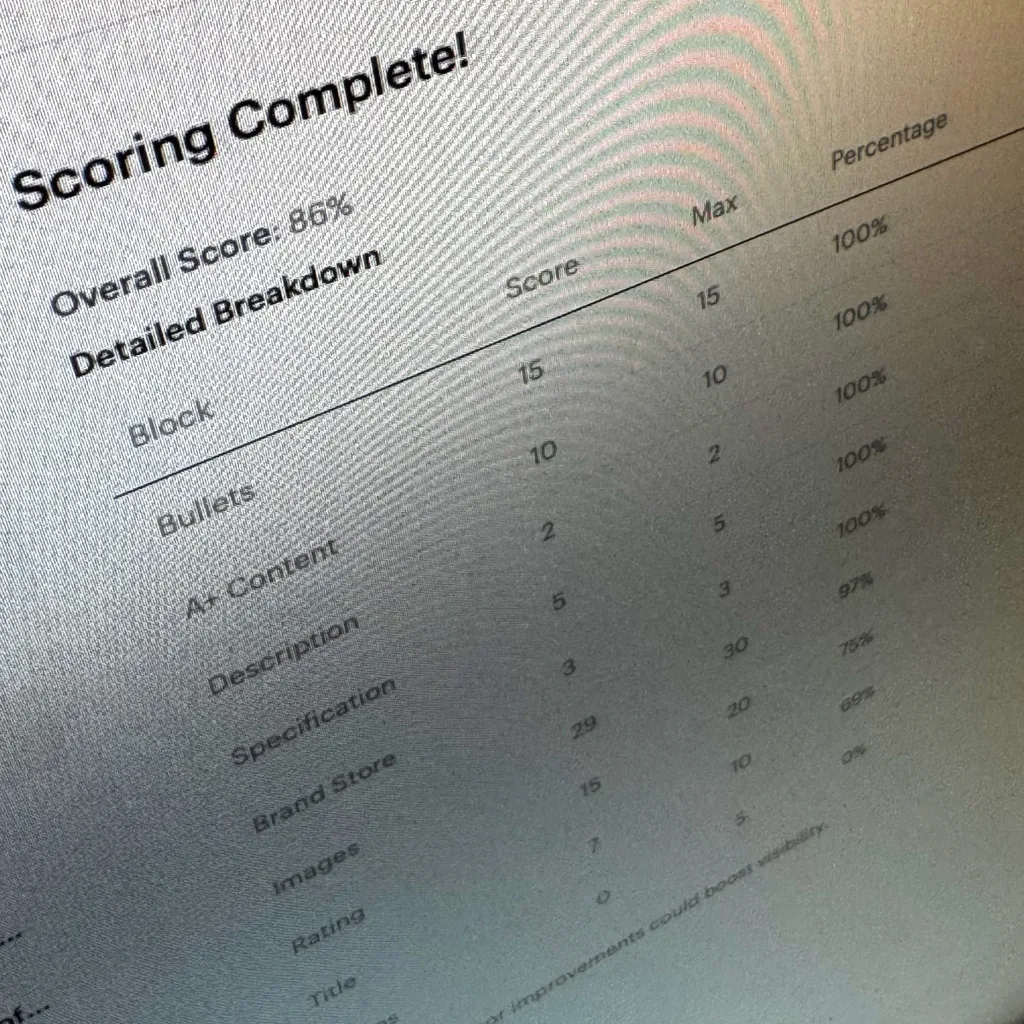
A single 0–100 score plus transparent weights for each factor—title relevance, media completeness, attribute coverage, review signals. You see exactly which element drags performance down and by how much, turning a number into a roadmap.

Validation Checklist per Marketplace

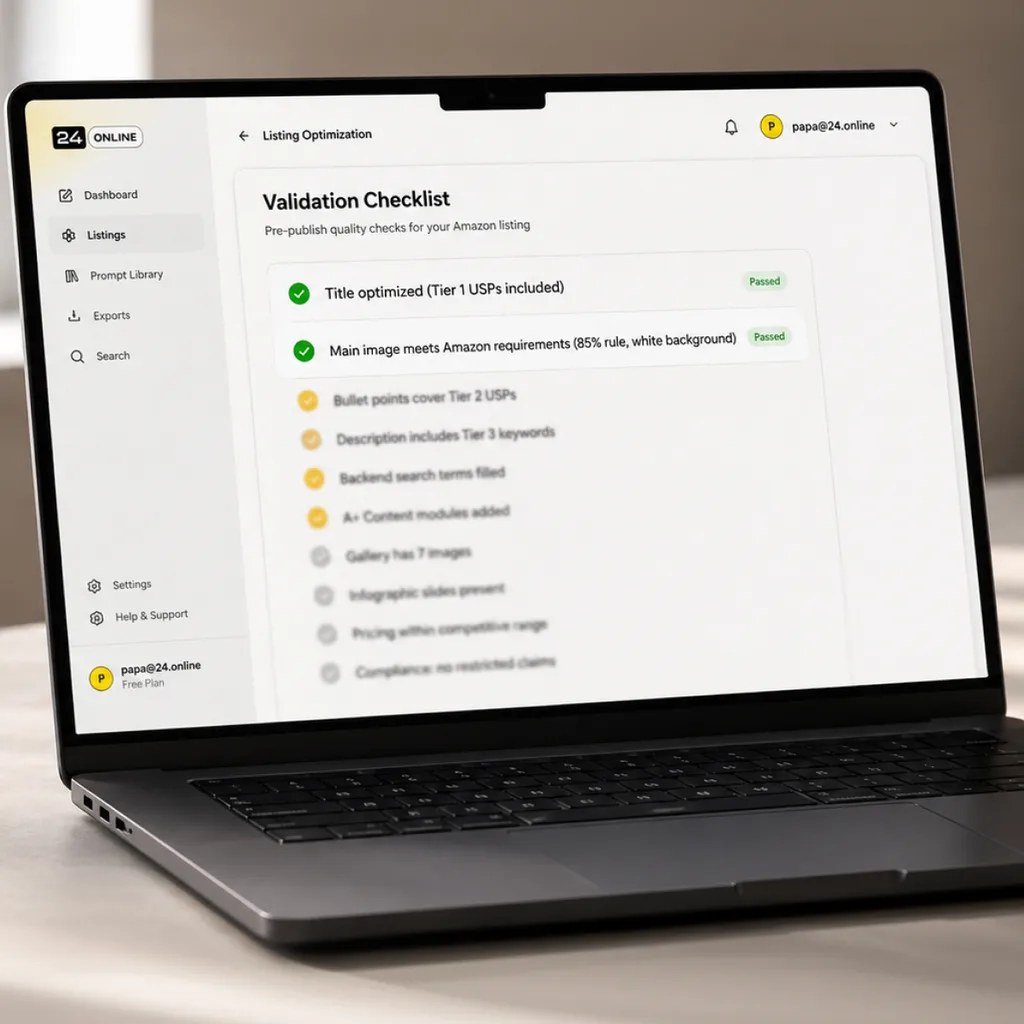
A line-by-line product listing QA against Amazon, Walmart, Shopify, Etsy, and eBay requirements. Each rule shows pass, warning, or fail status with a direct link to the field that needs attention—no hunting through seller dashboards.

Prioritized Fix Plan with Expected Impact

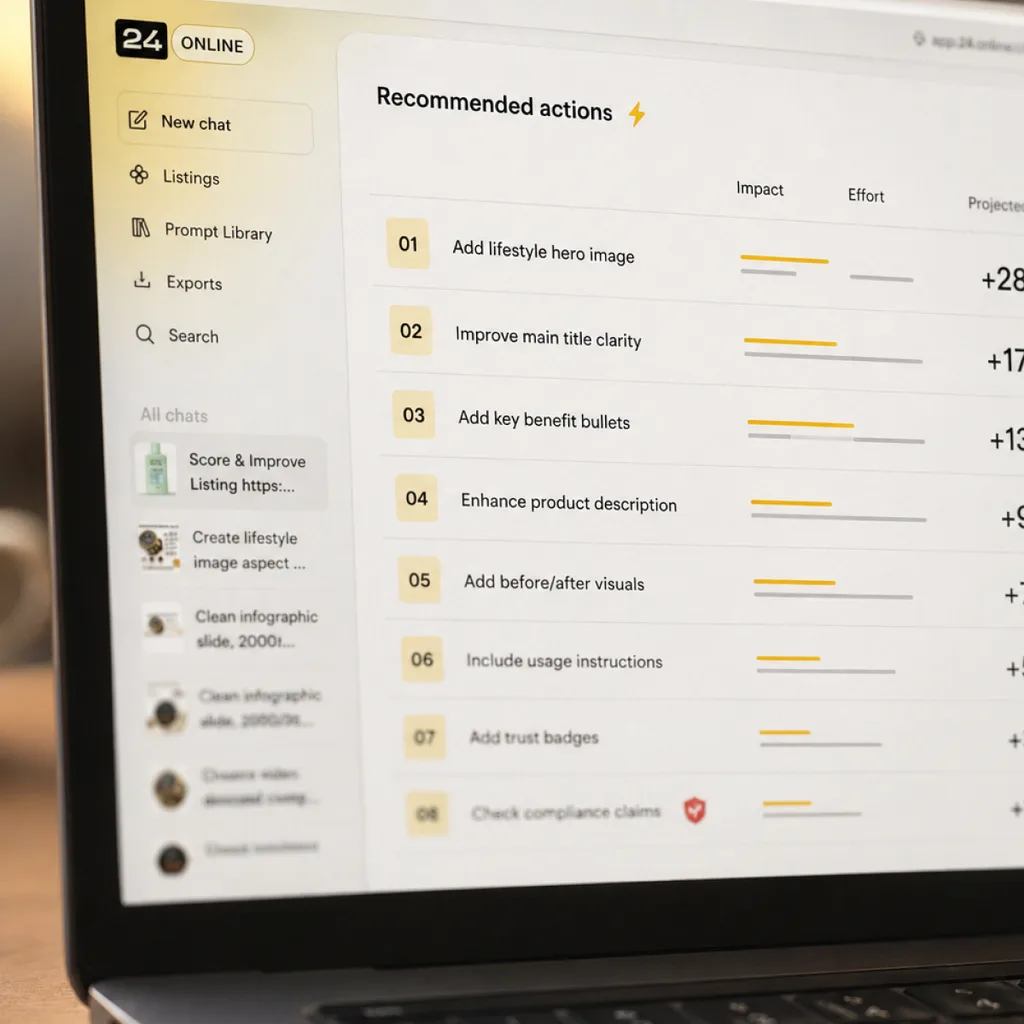
Fixes ranked by projected uplift versus effort. High-impact, low-effort items surface first; risky changes that could break compliance are flagged before you touch them. The listing optimization checklist becomes a sequenced to-do list, not a wall of findings.

Exportable Audit Report

A ready-to-share listing audit report in PDF or CSV. Hand it to leadership for quarterly reviews, attach it to vendor tickets, or import it into your project tracker. Every change, every score, every recommendation—documented and versioned.

Audit Preview
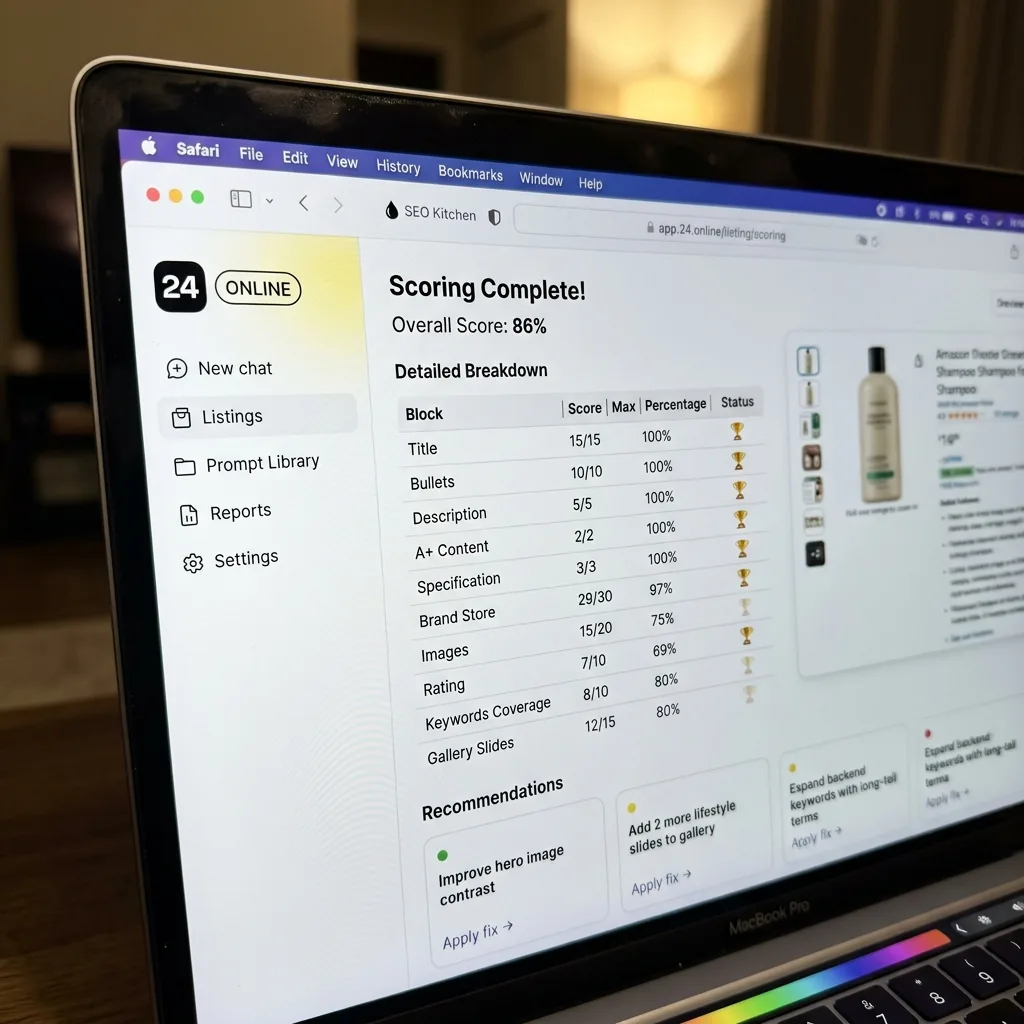
Quality score dashboard showing factor breakdown across title, media, and attributes
Sample audit output: score breakdown
Marketplace validation checklist interface indicating pass and fail statuses
Validation checklist inside the 24.online dashboard
Prioritized fix plan table sorted by expected impact and effort
Prioritized fix plan mapped to projected uplift

How the Listing Quality Score Works

A Listing Quality Score is a data-driven metric that measures how well your product listing meets the criteria that influence discoverability and conversion on a given marketplace. 24.online calculates this score by analyzing five core dimensions of every listing: title and keyword relevance, media completeness, attribute accuracy, compliance with platform requirements, and review signals. Each dimension is weighted according to its documented impact on search ranking and customer experience, then normalized against top performers in the same category and market—so your score reflects where you actually stand relative to direct competitors, not an abstract ideal.

The scoring engine pulls live data from your connected seller accounts: catalog content, product images and video, structured attributes, category taxonomy, customer reviews, and return reason codes. It cross-references this information against each marketplace's published listing guidelines—such as Amazon's Style Guides and Walmart's Item Spec 5.0—to flag gaps that suppress visibility or trigger suppression. Because requirements differ by category and region, 24.online recalibrates thresholds automatically: a compliant electronics listing in the US looks different from a compliant apparel listing in Germany, and your score accounts for that context.

The Listing Quality Score does not predict sales or promise overnight results. What it does is surface the specific, fixable issues—missing bullet points, undersized images, incomplete variation attributes—that measurably drag down click-through and add-to-cart rates, so you know exactly where to focus. Leading e-commerce teams already use listing analyzers as real-time feedback while editing content; 24.online extends that practice by connecting every flagged issue to a recommended fix and a projected impact estimate.

Title keyword coverage and query relevance against category search terms. Image count, resolution, background compliance, and presence of infographics or lifestyle shots. Bullet and description completeness, readability, and keyword density. Required and recommended attribute fill rate per marketplace taxonomy. Review volume, average rating, sentiment trends, and top return reasons. Compliance with platform-specific content policies and suppression triggers.
We do not infer causation between a single content change and sales lift without controlled testing. We do not access or factor in your advertising spend, external traffic sources, or pricing strategy—those influence sales but sit outside listing content quality. We do not guess at marketplace algorithm weights; our model relies on documented guidelines, observed ranking correlations, and category benchmarks updated weekly.
Data Coverage
Low Medium High
Compare Context
My Listing
Benchmark
Schema of Scoring pipeline: from raw listing data to actionable, category-normalized quality score. Shot from a MacBook display with a shallow depth of field effect.
MacBook Pro

Scoring pipeline: from raw listing data to actionable, category-normalized quality score.

Why Listing Quality Drives Search Share and Conversion

Better content and attributes don't just look good—they move the metrics that determine how many shoppers see your product and how many of those shoppers buy.

Every sale on a marketplace starts the same way: a shopper searches, the platform decides which products to show, and the shopper chooses one. Your listing quality directly influences each step of that sequence. When your titles, images, and attributes align with what shoppers and algorithms expect, you earn more visibility. When that visibility meets a well-constructed product page, more clicks convert into purchases. This is not a theory—it is the operational logic that marketplace algorithms use to allocate traffic.

Key Metrics Explained

Share of Search

Share of search measures how often your brand or product appears when shoppers search relevant terms. It reflects demand and interest—essentially, how much of the conversation in your category includes you. Research from industry analysts has shown that changes in share of search often correlate with shifts in market share over subsequent periods, making it a leading indicator of competitive momentum.

Share of Voice

Share of voice captures your visibility across a marketplace's surfaces: search results, category pages, sponsored placements, and recommendations. While share of search tracks whether shoppers are looking for you, share of voice measures whether the platform is showing you. Both depend heavily on listing quality signals—relevance, completeness, and content strength.

The Path from Visibility to Revenue

1

Visibility

Algorithms evaluate your listing's relevance, completeness, and historical performance. Listings with optimized titles, accurate attributes, and strong media signals rank higher and appear in more searches. Higher visibility means more impressions.

2

Click

Shoppers scanning results make split-second decisions. Your main image, title clarity, price, rating, and Prime/fulfillment badge determine whether they click. Click-through rate (CTR) directly reflects how compelling your listing appears relative to competitors on the same page.

3

Conversion

Once a shopper lands on your page, detailed images, complete bullet points, accurate specifications, and positive reviews reduce hesitation. Conversion rate (CVR) measures how effectively your listing turns interest into a purchase decision.

4

Revenue

When CTR rises and CVR holds steady—or improves—sessions convert into revenue faster. Each percentage point gained in visibility or conversion compounds across your entire catalog.

These four stages form a closed loop. Marketplace algorithms monitor conversion signals and feed that data back into ranking decisions. A listing that converts well earns more visibility, which generates more clicks, which produces more conversions—a reinforcing cycle. Conversely, poor listing quality creates a downward spiral: low relevance leads to fewer impressions, weaker CTR, declining sales velocity, and further ranking losses.

Illustrative Scenario

Consider a catalog of 500 SKUs averaging 1,000 monthly sessions each at a 10% conversion rate. If listing improvements lift CTR by 15% and hold CVR constant, those same rankings now deliver 1,150 sessions per SKU—an additional 75,000 sessions across the catalog each month. At a $25 average order value, that incremental traffic represents significant revenue potential, assuming conversion rates remain stable. The actual impact varies by category, competition, price point, and offer strength, but the directional relationship holds: better listings capture more of the available demand.

Explore the Impact

This is a directional estimate. Your actual lift depends on category, competition, and the depth of optimization — book an audit to get a calibrated forecast for your listings.

Additional Sessions

+0

Proj. Incremental Revenue

+$0

+$0/year

Based on a 15% CTR lift across your current funnel. Most 24.online clients see 12–25% improvement in the first 60 days.

Understanding this chain is essential, but measurement without action changes nothing. The Listing Quality Score quantifies where your listings underperform at each stage—visibility, click appeal, or conversion readiness—so you know exactly which improvements will move which metrics. The next sections break down each factor in detail.

Disclaimer: Results depend on your specific category, competitive landscape, pricing, inventory availability, and the quality of your existing listings. The figures above are illustrative, not guaranteed outcomes. Every catalog responds differently to optimization, and 24.online provides projected impact estimates based on your actual data—not generic benchmarks.

Factor Map: What Your Score Is Made Of

Your Listing Quality Score breaks down into four measurable pillars, each tied to a specific stage of the buyer journey. Title and keyword relevance determine whether shoppers find you in the first place. Media quality shapes first impressions and drives click-through. Attribute completeness controls filter visibility and sets accurate expectations. Review signals reveal friction points that erode conversion and inflate returns. When any pillar underperforms, revenue leaks at a predictable point in the funnel—and the fix becomes clear.

Title & Query Relevance

Simulated SERP Evaluation Amazon Schema
Primary Keyword — Secondary Value Prop, Technical Spec 1, duplicate keyword fluff that hurts readability
Readability vs. Keyword Coverage Optimal Balance

We check titles for search relevance and clarity—not style points. The goal is matching real shopper queries while communicating key product attributes within the first few words. Front-loading matters because search results and mobile screens truncate aggressively; if your differentiator sits at the end, most buyers never see it.

Title rules vary by marketplace. Amazon rewards keyword-rich titles that capture multiple search intents, while Etsy explicitly recommends clarity over density—pushing secondary details into tags and attributes. A title optimized for one channel can underperform or even violate guidelines on another. Our checks flag platform-specific mismatches so you can adapt without guesswork.

We also score uniqueness. Duplicate or near-duplicate titles across your catalog confuse algorithms and shoppers alike, diluting your own search presence and making it harder for buyers to distinguish variants.

Common Failures

  • Rewrite title to front-load primary use case and key differentiator
  • Remove duplicate keywords that add no search value
  • Shorten title to fit mobile truncation without losing meaning
  • Add missing product type or category term for query matching
  • Align title structure to platform guidelines (Amazon vs. Etsy vs. Walmart)

Media & Visual Proof

Product hero image evaluation mockup
Hero Image Effectiveness
85% Match
A-
Product secondary image evaluation mockup
Information Density
Text Warning
!

Images and video do more than decorate a listing—they answer objections, prove value, and set expectations that either convert browsers into buyers or trigger returns later. We evaluate media for clarity of the value proposition, information density, and alignment with category norms. A hero image that fails to communicate what the product does in a single glance costs you clicks before the listing even loads.

Beyond the main image, secondary slots should systematically address common questions: scale and dimensions, context of use, material or texture close-ups, and any included accessories. Infographics work when they're legible on mobile; when text shrinks below readability, they become visual noise. Style consistency across slots builds trust; a jarring mix of backgrounds and lighting signals carelessness.

For brands using A+ Content or Enhanced Brand Content, media quality directly influences purchase confidence. Well-designed comparison modules and lifestyle imagery reduce hesitation, clarify variant differences, and lower post-purchase regret—one of the primary drivers of returns.

Common Failures

  • Replace hero image to clarify value proposition in one glance
  • Add scale reference image showing product dimensions in context
  • Resize infographic text for mobile legibility
  • Include lifestyle shot demonstrating real-world use
  • Standardize background and lighting across all image slots
  • Add product video to reduce uncertainty and boost conversion

Attributes & Spec Completeness

Required Attribute Coverage Critical
100% Covered
Filter-Enabled Attributes Discoverability
60% Covered (Missing 4 fields)
Recommended Attribute Coverage Tabular Specs
35% Covered

Attributes control discoverability in ways that titles and descriptions cannot. Filter attributes determine whether your product appears when shoppers narrow results by size, color, material, or feature. Tabular specs populate the structured data blocks buyers scan before scrolling to reviews. Missing or inaccurate attributes don't just hurt search ranking—they can suppress your listing entirely or route it to the wrong category, where it competes against irrelevant products.

Each marketplace maintains its own taxonomy. Walmart's Item Spec 5.0 standard, for example, introduced granular attribute requirements designed to improve product matching and filter accuracy. Listings that ignore these specifications lose visibility in guided navigation and risk compliance flags. Amazon's category-specific requirements shift frequently, and what passed validation last quarter may trigger warnings today.

We map your attribute coverage against required, recommended, and high-impact optional fields—distinguishing between attributes that prevent suppression, attributes that unlock filters, and attributes that improve the tabular spec view shoppers rely on for quick comparisons.

Common Failures

  • Add missing filter attributes to appear in refined search results
  • Correct category mapping to reach the right browse node
  • Fill required specs to resolve suppression or compliance warnings
  • Update attributes to meet Walmart Item Spec 5.0 requirements
  • Populate tabular spec fields that buyers compare before purchasing

Reviews & Returns Signals

Sentiment Trend
Last 90 Days
Expectation Mismatch
Actionable via listing
Quality Issues
Requires product fix

Rating trend over the past 90 days, with review volume and sentiment breakdown by theme.

Review analysis isn't about gaming ratings—it's about converting customer pain into listing improvements. We cluster feedback by theme and map complaints to specific elements you can fix: a recurring gripe about size often traces back to missing dimension photos or incomplete specs; confusion about compatibility points to unclear bullet copy or absent attributes.

The distinction between quality issues and expectation mismatches matters. Quality problems require product or supply chain fixes outside the listing. Expectation mismatches, however, are listing failures: the content promised something the product didn't deliver. These are actionable. A revised description, an added image, or a corrected attribute can prevent the same complaint from recurring.

We track sentiment trends over time so you catch reputational slides early. A sudden spike in negative reviews often correlates with a batch issue or a recent listing change that backfired. Seeing the pattern quickly lets you respond before the damage compounds—whether that means rolling back an edit, adding clarifying content, or escalating a fulfillment problem.

Common Failures

  • Add photo showing actual size to address recurring 'smaller than expected' complaints
  • Clarify material or texture in description to reduce 'not as pictured' returns
  • Update compatibility attributes flagged in negative reviews
  • Add A+ comparison module to prevent variant confusion
  • Revise bullets to set accurate expectations on common friction points

Validation Checklists Built for Your Marketplace, Category, and Product Type

Every marketplace publishes its own rulebook. Amazon enforces character limits. Walmart requires exact attribute mapping. Etsy penalizes missing tags. Your category adds another layer—electronics demand certifications, apparel needs size charts, groceries require nutritional data. A single missing field can suppress your listing from search or trigger a compliance flag. 24.online compiles these requirements into a single listing validation checklist your team can act on immediately—no guesswork, no cross-referencing PDFs, no missed deadlines.

One Checklist. Every Rule That Matters.

Our validation engine pulls from official marketplace documentation, category-specific attribute schemas, and product-type requirements to generate a marketplace compliance checklist tailored to each SKU. You see exactly what's required, what's recommended, and what's blocking publication—organized by severity and filtered by the platform you're optimizing.

Walmart Item Spec 5.0: Why Attribute Precision Matters Now

Walmart's Item Spec 5.0 introduced stricter attribute requirements across all categories. Listings that don't conform face reduced visibility in search and filters—or outright rejection. 24.online performs Walmart Item Spec 5.0 validation against current standards, flagging missing or malformed attributes before they cost you placement. This isn't optional compliance; it's the baseline for showing up where customers search.

From Validation to Action

Each checklist item includes the specific requirement, the current state of your listing, and a clear pass/fail status. When something fails, you see why—and you can convert that line item into a task for your team or let 24.online's AI agent draft the fix. No ambiguity, no hunting through help docs. For teams managing hundreds or thousands of SKUs, this turns audit chaos into a structured workflow. Hand the checklist to a content specialist, a virtual assistant, or your agency. Everyone sees the same priorities, the same criteria, the same path to compliant, high-performing listings.

Why Compliance Drives Revenue

Validation isn't busywork. Incomplete Amazon listing quality dashboard attributes or missing category fields reduce discoverability—your product won't appear when shoppers filter by size, material, or feature. Ambiguous specifications increase returns because customers receive something different from what they expected. A validated listing performs better in search, converts at higher rates, and generates fewer post-purchase problems.

Listing Validation Dashboard

BLOCKER
Amazon Logo

Platform-Specific Rules

Character limits exceeded. Prohibited phrases found in bullet points. Formatting standards for Amazon violated.

BLOCKER
Walmart Logo

Category Attribute Requirements

Mandatory attributes missing based on your product taxonomy. Validated against current schema.

WARNING
Etsy Logo

Media Compliance

Image resolution below minimum requirements. Background requirements and infographic policies need review.

PASSED
Shopify Logo

Policy and Compliance Flags

No restricted keywords, claim substantiation issues, or missing certifications detected.

OPPORTUNITY
eBay Logo

Optimization Opportunities

Fields that aren't required but improve ranking, filtering, and conversion are incomplete.

Swipe through each validation item.

Turn Diagnostics Into a Prioritized Action Plan

Not just a list of issues—a ranked, strategic listing optimization plan that shows exactly what to fix first, what to test, and what to escalate.

Finding problems is easy. Knowing which ones matter is where most teams stall. 24.online goes beyond diagnostics by applying uplift analysis to every issue it detects, then sorting your entire catalog's fixes into a prioritized queue. The result: a clear roadmap that tells you what to tackle now for quick wins, what to A/B test before scaling, and what requires brand or compliance sign-off before touching.

Choose Your Priority Strategy

Quick Wins

Surface low-effort fixes with immediate visibility or conversion impact. Ideal for fast results before peak season or a product launch.

Low Risk Impact: High Effort: Low

Add Missing Material-Type Attribute

Why:Because this attribute unlocks a high-traffic filter path where your product is currently hidden.

Low Risk Impact: Medium Effort: Low

Fix Truncated Mobile Title

Why:Ensures the most critical keywords are visible on mobile search results without expanding character counts.

Max Revenue Impact

Rank tasks by projected sales uplift regardless of effort. Best for teams ready to invest in high-return optimizations across large catalogs.

Moderate Risk Impact: Very High Effort: High

Rewrite Description & Initiate Test

Why:Requires A/B testing for product listings to validate uplift before scaling across similar SKUs. Potential 15% conversion lift.

Low Risk Impact: High Effort: Medium

Create Virtual Bundle with Top Seller

Why:Increases average order value by leveraging existing high-traffic ASINs without requiring new inventory.

Compliance First

Prioritize fixes that prevent listing suppression, policy violations, or catalog rejections. Essential for brands expanding to new marketplaces.

High Risk Impact: Critical Effort: Low

Remove Restricted Claim from Bullets

Why:Prevents immediate listing suppression and account-level policy warnings by removing non-compliant medical claims.

Moderate Risk Impact: High Effort: Medium

Update Main Image Background

Why:Current image violates marketplace pure-white background policy, risking automated delisting.

Impact × Effort: The Logic Behind Every Ranking

Each detected issue is scored on two axes. Impact estimates the potential lift in visibility, click-through rate, or conversion if the fix is applied—based on category benchmarks, historical performance, and marketplace-specific signals. Effort reflects the resources required: a missing attribute is a one-click correction, while a full title rewrite may need copywriting review and brand approval. Tasks that deliver strong impact with minimal effort rise to the top; high-effort changes that require A/B testing for product listings move into a separate validation queue.

Every Recommendation Comes With a "Why"

No black-box surprises. Each task in your listing optimization plan includes a plain-language explanation of why it ranks where it does—so you can audit the logic, adjust weights if your priorities differ, and confidently delegate work to your team or agency partners.

Projected Uplift—Transparent, Not Guaranteed

Where data supports it, 24.online surfaces a projected uplift range for each fix, expressed as a relative indicator rather than a hard promise. These forecasts draw on aggregated performance patterns across similar products and marketplaces, giving you directional guidance to prioritize listing improvements without overstating certainty. When projected impact is unclear, the system says so—because honest uncertainty beats false precision.

Prioritization in Practice

A home-goods brand ran a catalog audit and received two recommendations for the same SKU: rewrite the product description and add a missing material-type attribute. Traditional tools might list both as "medium priority." 24.online ranked the attribute fix higher—because that single field unlocks a filtered search path where the product was previously invisible. The description rewrite, while valuable, moved into the A/B testing queue for validation. One fix opened a new traffic channel immediately; the other entered a structured test cycle.

Understand the Risk Before You Commit

Not every change is reversible, and some carry compliance implications. Each task displays a risk indicator: low-risk items can be applied confidently, moderate-risk changes may affect branding consistency, and high-risk edits—like altering regulated claims—flag the need for legal or brand-team approval before execution. This visibility prevents costly missteps across client catalogs.

Agency Dashboard showing client portfolios

For Agencies

Agencies managing dozens of seller accounts can filter the prioritized queue by client, marketplace, or risk level—then export action plans as structured reports for client review or internal sprint planning.

Brand Analytics showing catalog health

For Brands

Brands with large catalogs gain a single view of their highest-leverage fixes across Amazon, Walmart, Shopify, and beyond—eliminating guesswork about where optimization resources will drive the greatest return.

Report Template

See Exactly What You Get: Sample Listing Audit Report

A complete listing optimization report you can share with your team, present to stakeholders, and use as your single source of truth for every change.

Every listing audit report from 24.online follows a structured format designed for clarity, action, and accountability. You receive a document that works equally well for a quick internal review or a formal presentation to leadership.

Overall Score & Breakdown

Captures listing health in a single number. See exactly how title relevance, media quality, and review signals impact your score.

Validation Checklist

Flags every requirement your listing meets or misses. Highlights compliance risks and optimization gaps in plain language.

Recommended Fixes

Translates diagnostics into prioritized actions with estimated impact levels. A clear path from current state to improved performance.

Change Log & Benchmarks

Records every modification as a verifiable audit trail. Compare your progress against category leaders on every scored factor.

Listing Diagnostics
Unoptimized product listing before audit Optimized product listing after audit implementation
Sample before and after listing optimization report showing overall score, factor breakdown, validation checklist, recommended fixes, change log, and category benchmark comparison.
Optimized product listing after audit implementation

From Score to Action: Turn Diagnostics Into Fixes Through a Chat-Based AI Agent

Listing Quality Score isn't a report you file away—it's the starting point for an AI seller agent that plans, executes, and tracks improvements across every marketplace you sell on.

Most listing audit tools stop at the diagnosis. You get a score, a list of problems, and then it's up to you to figure out what to fix, in what order, and how to actually get it done. 24.online works differently. The same AI that calculates your Listing Quality Score also acts as an autonomous agent capable of turning every flagged issue into a concrete task—planned, prioritized, and executable directly from a chat interface. This is AI listing optimization that doesn't end at analysis: it continues through implementation, verification, and ongoing improvement. Quality scoring becomes an operational workflow, not a one-time audit.

Sample Conversation
24.online Agent
Audit my 150 US Amazon listings and flag anything blocking conversions.
24.online Agent Logo Agent
Running audit now. I'll analyze titles, images, bullet points, A+ content, backend keywords, and attribute completeness against Amazon's current category requirements and your top competitors.
24.online Agent Logo Agent
Audit complete. 43 listings have critical issues. 71 have moderate gaps. 36 meet baseline quality. Here's the prioritized fix plan sorted by projected sales impact. Ready to review?
Show me the top 10 by impact.
24.online Agent Logo Agent
Top 10 listings by projected uplift: 1. SKU-4821 — Missing lifestyle images, weak title keyword coverage. Est. +18% CTR. 2. SKU-3309 — No A+ content, incomplete bullet points. Est. +12% conversion. 3. SKU-7745 — Backend keywords missing high-volume terms. Est. +9% impressions. ... Approve all, select specific fixes, or adjust priorities?
Approve fixes for SKU-4821 and SKU-3309. Hold the rest.
24.online Agent Logo Agent
Confirmed. Generating optimized titles, bullets, and image briefs for SKU-4821 and SKU-3309. Content drafts will be ready in 2 minutes. You'll review before anything is pushed live.

Task Queue

SKU-4821 — Title rewrite + 3 lifestyle images In progress
SKU-3309 — A+ module creation + bullet optimization Need approval
SKU-7745 — Backend keyword expansion On hold
Bulk sync to Walmart (38 SKUs) Scheduled

Choose Your Control Level

Review and approve every change before it's applied. Best for new users or sensitive SKUs.
Agent executes low-risk fixes automatically. High-impact changes require your approval.
Define guardrails—price boundaries, content guidelines, excluded SKUs—and let the agent operate continuously within limits.

Your Active Guardrails

  • Price changes limited to ±5% of current value
  • No auto-publish for SKUs with rating below 4.0
  • All title changes require human approval
  • Image uploads auto-approved if they pass compliance check

Whether you prefer hands-on control or hands-free listing optimization, the agent adapts to your workflow. Every action—approved or automated—is logged with timestamps, before/after snapshots, and rollback capability. When content generation or media creation is needed, it flows naturally as the next step in the task queue: the agent drafts new titles, generates image concepts, or builds A+ modules based on the gaps your Quality Score revealed. And because 24.online connects to Amazon, Walmart, Shopify, Etsy, and eBay through official APIs, multi-marketplace sync happens from the same conversation. Fix a listing once; push it everywhere with a single command.

Start Your Free Audit

Ready to turn your listing audit into an automated improvement engine?

Why This Matters

Connecting quality scoring directly to an AI seller agent eliminates the gap between knowing what's wrong and actually fixing it. Instead of exporting reports, assigning tasks in another tool, and manually uploading changes marketplace by marketplace, you move from diagnosis to resolution in one continuous workflow. The score isn't a static grade—it's a live input that drives continuous improvement, monitored and acted upon by an agent that learns which fixes deliver the biggest gains for your catalog.

Integrations and Security

Official APIs, granular permissions, and full audit transparency

24.online connects to your seller accounts exclusively through official seller API channels provided by each marketplace. We never ask for your login credentials. Instead, you authorize access via industry-standard OAuth flows or secure API tokens issued directly by the marketplace, giving you complete control over what we can see and do.

Supported Platforms

Authorized through Amazon Seller Central with configurable scope.

READ Listings, Sales, Reviews
WRITE Content, Images, Keywords

Connected via Walmart Seller Center and official API gateway for catalog and spec management. View Item Spec API

READ Items, Analytics, Reviews
WRITE Item Spec, Media, Attributes

OAuth authorization with per-store scope selection.

READ Products, Metafields, Analytics
WRITE Listings, Images, SEO fields

OAuth 2.0 authorization with shop-level consent.

READ Listings, Stats, Reviews
WRITE Titles, Descriptions, Tags

Authorized through eBay Developer Program with consent-based tokens.

READ Inventory, Orders, Seller Insights
WRITE Item descriptions, Images

You Control the Scope

When you connect a store, you choose exactly which permissions to grant. Need analysis only? Authorize read-only access—24.online will score your listings and deliver recommendations without ever pushing changes. Ready for hands-free optimization? Enable write access and let the AI agent apply approved updates directly. You can adjust or revoke permissions at any time from your marketplace's seller dashboard.

No Passwords. Tokens Only. Everything Logged.

Token-based access

24.online stores only the encrypted access tokens issued by each marketplace—never your username or password. If you revoke a token, our access ends instantly.

Action audit log

Every read request and every write operation is timestamped and recorded. You can review the full history of what 24.online accessed or changed, down to the individual field level.

Content rollback

For supported marketplaces, we retain a version history of your listing content before each update. If something goes wrong, you can restore the previous state directly from the change log—no support ticket required.

Enterprise teams trust official seller API integrations because they keep credentials safe, permissions transparent, and every action traceable. That's exactly how 24.online operates—secure by design, auditable by default.

Who Needs a Listing Quality Score—and When

Find your role, recognize your scenario, and see exactly what you walk away with.

Listing Quality Score for Amazon Sellers

You're watching sessions climb but conversion stall. Competitors win the Buy Box with weaker products. Suppressed listings blindside you mid-campaign. You need clarity on what's actually broken—fast.

New SKU Launch

Before your product goes live, run a pre-launch audit. You receive a score with a prioritized checklist flagging missing backend keywords, undersized images, and incomplete variation relationships. Fix these before launch and avoid the slow start that buries new ASINs.

Sales Drop Investigation

Revenue dipped 18% last month and you don't know why. The quality score report surfaces the root cause: a competitor added video, your bullet points lost keyword coverage after an edit, and three critical attributes went blank during a feed sync. You get an action plan ranked by estimated sales impact.

Output Summary

Score card, attribute gap checklist, image compliance audit, keyword coverage report, and a prioritized fix plan you can execute in a single afternoon.

Audit your Amazon listings now

Validation Checklist for Walmart Items

Walmart Item Spec 5.0 compliance errors reject your listings silently. Rich media modules sit empty. Your items fail to surface in category filters because attributes are missing or mis-mapped. You're losing share of search to sellers who simply filled in more fields.

Attribute Compliance Fix

You uploaded 400 SKUs but 120 show "Limited content" badges. The validation checklist pinpoints exactly which attributes each item is missing—shelf description, key features, variant groupings—and maps them to Walmart's latest taxonomy so your team knows precisely what to submit.

Marketplace Expansion

You're moving an established Amazon catalog to Walmart. A multi-marketplace listing audit compares your current content against Walmart's requirements, highlights what transfers cleanly, and generates a gap report for titles, images, and specs that need adaptation.

Output Summary

Spec 5.0 compliance checklist, attribute completion matrix, taxonomy mapping report, and a migration-ready gap analysis.

Check Walmart compliance now

Catalog Audit for Brand Teams

Your products appear on dozens of retailer sites, but content quality varies wildly. Distributors upload outdated images. Descriptions drift from brand guidelines. You lack a single view of where your listings underperform—and no scalable way to fix them.

Catalog-Wide Cleanup

You inherited a 2,000-SKU catalog after a product line acquisition. The listing quality score surfaces the 15% of items dragging down your average—wrong hero images, missing A+ content, truncated titles. You receive a prioritized plan that lets your team tackle high-impact fixes first and track progress week over week.

Seasonal Prep

Holiday traffic is eight weeks out. A quality audit identifies which top-100 revenue SKUs still lack video, which product pages have declining star ratings, and where competitors have stronger lifestyle imagery. You get a punch list and projected uplift estimates so leadership can allocate budget before the traffic surge.

Output Summary

Portfolio-level score dashboard, brand-compliance checklist, content gap heatmap, and a quarterly improvement roadmap.

Audit your brand catalog

Listing Quality Score for Agencies

Clients ask why rankings slipped, but you're stuck doing manual audits that eat margin. You need a repeatable diagnostic that proves value fast, scales across client accounts, and produces deliverables you can white-label.

Client Onboarding Diagnostic

A new brand signs with your agency. Within hours you deliver a comprehensive score report covering title optimization, image compliance, attribute completeness, and review sentiment across their entire Amazon and Walmart catalog. The client sees exactly where they stand—and what your team will fix first.

Ongoing Performance Reviews

Each month you generate comparison reports showing score improvements, checklist items resolved, and remaining opportunities. Clients get a clear narrative: content quality rose 22 points, estimated traffic impact is +14%, and next month's focus is video and A+ modules.

Output Summary

White-label audit reports, cross-marketplace scorecards, before/after change logs, and exportable data for client dashboards.

Scale your audits with 24.online

Multi-Marketplace Listing Audit

You sell on Amazon, Walmart, Shopify, and eBay—but content drifts out of sync. A fix on one channel doesn't reach the others. You waste hours comparing spreadsheets and still miss compliance gaps that cost you visibility.

Cross-Channel Sync Check

After a product refresh, you need to verify that updated titles, images, and specs propagated correctly everywhere. The multi-marketplace audit compares each channel side by side, flags discrepancies, and generates a sync checklist so nothing falls through the cracks.

New Channel Launch

You're adding Etsy to your mix. The quality score surfaces which existing SKUs meet Etsy's content standards, which need adjusted imagery, and which require new keyword-rich descriptions tuned for Etsy search. You get a channel-specific action plan instead of starting from scratch.

Output Summary

Unified cross-channel score, platform-by-platform gap analysis, sync discrepancy report, and a channel expansion checklist.

Audit all your channels at once

Works for 50 SKUs or 50,000

Solo sellers run single-product audits to nail launch content. Mid-size brands schedule weekly catalog scans to catch drift before it hits revenue. Enterprise teams integrate the quality score into their PIM workflows for continuous compliance. The output scales—same methodology, same actionable artifacts, whether you manage a curated boutique catalog or a sprawling assortment.

When to Run a Quality Score Audit

Before launching a new SKU Catch missing fields and compliance issues before they suppress your listing.
After a sales drop Diagnose whether content degradation, competitive gaps, or attribute errors caused the decline.
During catalog cleanup Prioritize which of your underperforming listings deserve attention first.
Before expanding to a new marketplace Identify what content transfers cleanly and what needs adaptation.
When fixing attribute or taxonomy issues Get a clear map of what's missing, mis-mapped, or out of spec.
After negative reviews spike Understand which product-page elements might be setting wrong expectations and driving returns.

Frequently Asked Questions

Your score updates automatically every 24 hours for connected accounts. When you make changes to a listing, you can trigger an instant rescore from the dashboard. Bulk catalog rescans run nightly, so you always see yesterday's reality, not last month's guess.
We support Amazon (US, CA, MX, UK, DE, FR, IT, ES, JP, AU, and more), Walmart US, Etsy, Shopify storefronts, and eBay. New regions and platforms are added based on customer demand. See the Integrations and Security section above for full API coverage details.
Each child ASIN or SKU gets its own score. Parent listings receive an aggregate score plus a breakdown showing which variations drag down the average. This way, you fix the weakest variant first instead of guessing.
Yes. During onboarding, you choose read-only or read-write access. Read-only lets you audit, score, and generate recommendations without any changes touching your live listings. You can upgrade permissions later when you're ready.
Absolutely. Once you approve a fix, one click syncs the updated title, bullets, images, or attributes to your seller account via official API. Review the From Score to Actions section to see how the chat agent walks you through each change.
Walmart Item Spec 5.0 is Walmart's latest content standard. Our validation engine checks your listings against every required and recommended attribute, image rule, and character limit defined in that spec. Failing validation can suppress your listing from search or block it entirely—our checklist flags issues before Walmart does.
The score itself is an internal diagnostic—it doesn't transmit to marketplaces. However, the factors we measure (keyword coverage, image count, attribute completeness, review sentiment) directly influence how algorithms rank and surface your product. Improving your score typically lifts share of search and conversion. See the Business Impact section for the data behind that link.
Helium 10 and Jungle Scout focus on keyword research and competitor spying. 24.online goes further: we score, validate, generate fixes, and push updates—all through an AI agent you chat with. Instead of juggling dashboards and copy-pasting suggestions, you approve changes in conversation and they go live. It's an AI employee, not another analytics tab.
Credits are the unit of AI work. Generating a new title costs credits; so does creating an image variant or running a deep competitive analysis. Viewing your existing score or browsing recommendations is free. Free accounts refresh 100 credits daily; paid plans add a monthly pool on top. Check the final CTA section for plan comparisons.
Validation checks whether your listing meets hard rules that can block or suppress it—character limits, prohibited words, required attributes, image dimension minimums, category-specific fields. It's pass/fail compliance. Scoring, by contrast, measures how well optimized your content is. Both appear in your report; validation errors always show first because they're urgent.
Start with the prioritized fix list in your report—it ranks issues by impact and effort. Tackle validation failures first (they can kill visibility), then move to high-impact, low-effort wins like adding missing images or enriching bullet points. The Priority and Impact section explains the scoring logic behind those recommendations.
Yes. We connect through each marketplace's official OAuth flow and store only access tokens—never your password. All API calls are logged in an audit trail you can review anytime. Permissions are scoped to exactly what you allow: read-only or read-write, listing data only or ads included. Details are in the Integrations and Security section.
For most catalogs under 5,000 SKUs, the initial scan completes in under an hour. Larger catalogs (tens of thousands of ASINs) may take a few hours as we pull and analyze every listing, image, and review. You'll see progress in real time and get a notification when the full report is ready.
Yes. Every report can be exported as a PDF summary or a detailed CSV with per-SKU scores, issue codes, and recommended actions. Agencies often use the export to share audit results with brand clients before starting optimization work.
The methodology is transparent—see the How the Score Is Calculated section for factor weights. If a specific recommendation doesn't fit your brand voice or strategy, dismiss it in the dashboard. The agent learns your preferences over time and adjusts future suggestions accordingly.
Start Optimizing

Your Listing Quality Score and Validation Checklist—Ready in Minutes

See exactly what's hurting your rankings and get a prioritized fix list you can act on today.


Daily Refresh Model

Every account gets 100 credits refreshed daily—enough to audit multiple listings at no cost. Credits are used when you generate new content or run advanced analysis; basic quality scoring and validation checklists are covered by your daily refresh.

Enterprise & Agencies

Managing thousands of SKUs or need a dedicated onboarding? Talk to our team about Enterprise and Agency plans.

Contact Sales